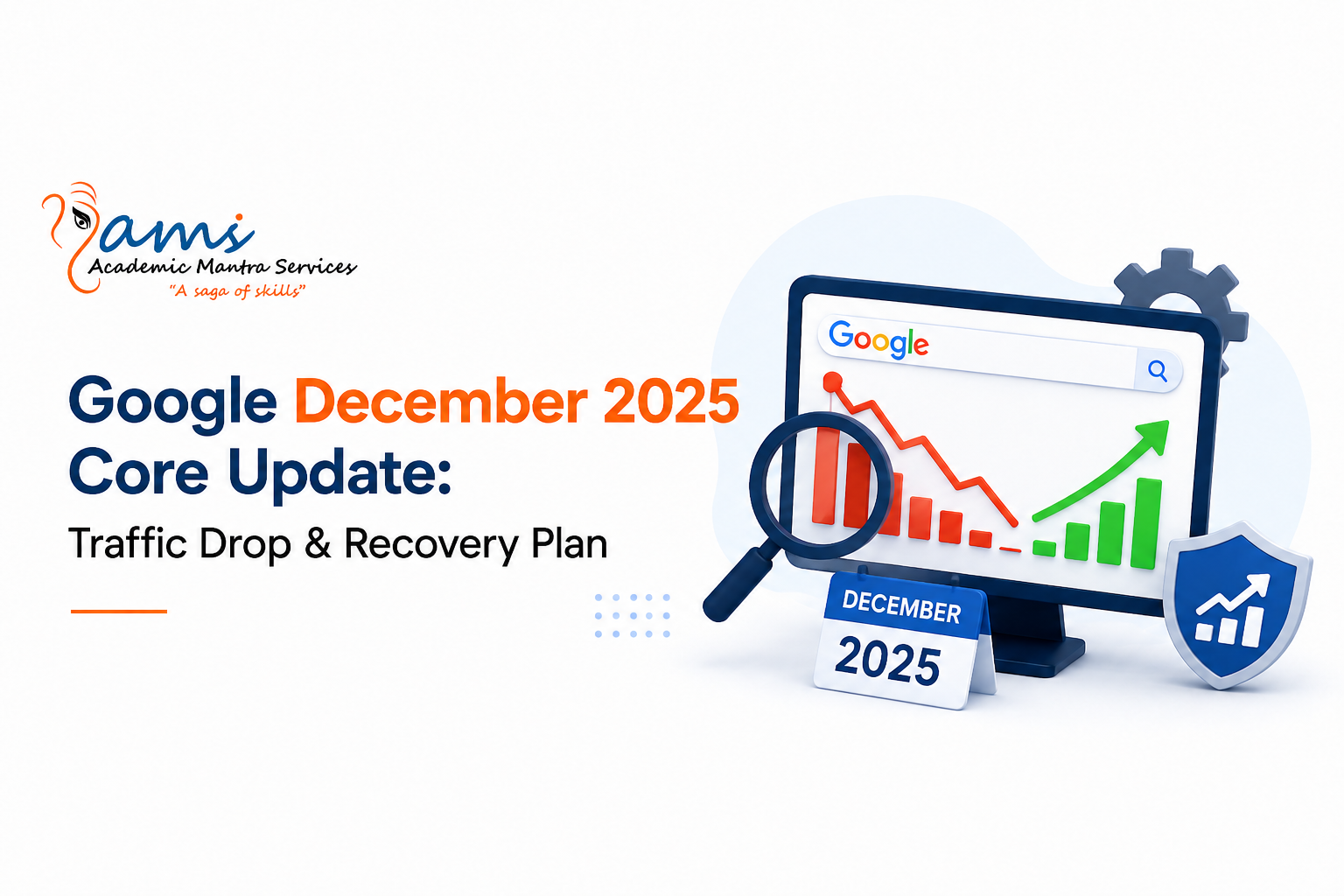
The exact dates, though, differed in the earlier studies, while the data on Google, which refers toit as a small update, is as mentioned. The core update of December began in the 2nd week, andthe major impact was clearly visible by 15th December, including some websites within our purview, which are listed below for the study at hand.
The core update in Dec 2025 is categorised by the industry and SEO fraternity as the harshest in Google's history. Though its a bit early and the characterisation may still be under consideration, but almost all available documents and studies, including AI, confirm the same. The factors behind this analysis include Semrush's high volatility (rated 8.7/10) and the website losing positions and traffic overnight, even for older domains. A major shift: Google has now structurally prioritised user experience over sites that stuff keywords and don't engage clients with relevant search queries, leading to higher bounce rates. It is looking to prioritise content relevance and move away from the traditional approach, thereby undermining age-old SEO beliefs.
Although the same was done in a phase-wise manner, initiated in early 2024, Google, to maintain its dominance and stay relevant in the new age, faced challenges from other AI platforms and began optimising its responses to real-world user expectations and customer delight. This can be mapped to their fundamental quality matrix, represented by EEAT (experience, expertise, authority, and trust). The matrix serves as a guideline for meeting standards and has been a major principle for all their updates since 2022. If you are a businessman looking to scale or improve your performance in response to these changes, this study will be key for you, as Google released 2 significant core updates during this 18-day period, thus impacting all sites and content in any language across the globe.
As per the Google Search Central document for developers, they prioritise search signals based on meaning, relevance, quality, usability, and context. They regularly do these core updates, which impact search algorithms and systems. Most of us will not have a clue unless traffic gets hit. And this time, since it impacts 40-60% of websites (the number may vary from 40-80%, as per the category of sites like news, reference sites, YMYL), the update is being seen as a big step forward in how Google is looking to penalise any content that is not meeting the EEAT standard.
Digging deeper, we can find that the 18-day rollout that affected almost 40% of the businessworldwide was a step toward Google prioritising user delight and content relevance.
As per a recent interview with Nobel laureate Geoffrey Hinton , known for his contributions to physics and regarded as the father of AI, only a few companies are prioritising the use of safe AI and minimising the negative infiltration of AI. He named Google and Anthropic in his observation, which are pursuing safe control over AI to limit its misuse, but he warns the world of its implications if not limited, as we can't slow it down anymore. Countries and companies are in a cat race to have an edge over each other, and with that in mind, we can't have the button to slow down in our diction. A recent email from Google to all its Gmail users corroborates the statement, announcing that it won’t use any unauthorised platforms to source data for its search engine and AI platforms.
Previous core updates:
Here’s a timeline and our coverage of recent core updates:
The series of core updates so far, before Google pushed the final hammer. ( We will follow up the study with a related article on all the core updates so far, as listed above, by Mar 2026 for our users.)
The Insights:
We have summarised our findings and insights for the December 2025 core update in the report below.
The analyses are based on our Google data analysis, key observations from live case studies affected by the update, and screening of multiple platforms and tools for algorithm changes and updates, conducted by the editorial team for the last few days under the able guidance of Abhijeet Rajkeins and Mukti Sharma, who are part of the editorial team across multiple areas shaping careers and skills for Indian students. Both of them are the content leaders aligning creativity and business goals, with 15+ years of experience between them in driving impact stories, case studies, and brand strategies that shape the ecosystem in the digital and academic space, while leading SEO and AI content as a specialist head, delivering measurable results through research-based solutions.
The study also draws on insights from discussions with professionals such as award-winning Pascal Bornet from Miami, Florida; Rusty Brick; and Barry Schwtcz, all AI professionals working in the same field.
The Analysis and Impact:
Some of the Business verticals impacted are Media, News reference sites, finance, e-commerce, health, medical, Gaming and a few others. YMYL and finance sites saw the biggest surges or drops, and among those, finance was the hardest hit. YMYL sites, which were also part of the key business sectors, impacted by the Dec 25 update, saw significant volatility, driving traffic to nose-dive. The data are sourced from available internet sources, including Google Gemini and AI searches.
The recommendations and solution: Why will the current study be an added benefit?
For our readers and users, it is based on real-time observation of some of our key sites. Additionally, our insights are supported by the observation that 99% of our sites saw an increase in organic traffic, from an average daily traffic of 5000 to 10000+ users, following the Google core update, with only a handful of sites impacted. ( Our follow-up article, real case study articles highlighting some examples of these websites, will be available for our readers by February 2026. Also, the fact that we have underlined certain best practices even before the AI or Google core update hit the market to enhance user experience and user delight when operating the webpages we handle shows our visionary approach and our understanding of advanced SEO and EEAT expertise. Some of the best practices we have undertaken are highlighting the daily queries, daily assistance, the real results section, and the Q&A section. One of our major highlights was improving the relevance and user experience in the very 1st section of our webpage, so a client doesn’t have to navigate from the landing page to avail of any options, with real-time data on the entire services, samples, reviews, current work, and results, all displayed in one go.
Before you plunge in with the highlighted changes, we have listed a few expert pointers as a reference for the changes you want to undertake. These insights are from our experience in handling real clients who are impacted. Though the impact is largely EEAT-based, the recovery roadmap will be slow and involve multiple layers of learning. Thus, our methodology here is a structural approach to the high-priority analysis of the impacted sites and a stepwise recovery journey. Instead of launching all the changes in one go, follow a phased approach and regularly review similar studies and recovery insights. As the impact is new, these studies will be floated later, after successful recovery statistics emerge.
A step-wise highlight of the roadmap for recovery:
The affected site may have the following attributes
- 7. The top traffic pages were hit first in this update, and the smaller pages were impacted later, but the recovery can be just the opposite.
- 8. Try to fix the 404-page errors, if any, with proper redirected pages, as most of the sites hit by the December core update had 404 pages.
- 9. Check for dedicated pages for Privacy policy, refund, and compliance.
Now let’s study the changes you can pursue based on the above impacts. If your site is not visible in any related keyword searches compared to previous searches, Google has suppressed your site from the ranking index due to the new EEAT matrices. This means Google has not blacklisted your site, as this is done by the new software Google has updated, which would require you to make structural and content changes as per the new EEAT guidelines. Google will evaluate your sites and learn from the signals of the improvements you make, and it might take some time for your ranking to improve.
The changes you need to pursue, based on on-page crawling, content evaluation, and alignment with the December 2025 core update:
Focus on E-E-A-T:
i . Experience: You should try to create helpful, reliable and people-first content to improve the experience on your site and reduce bounce rates. Google has also made it compulsory that all rankings be calculated based on user experience and delight on mobile devices. Thus, a site speed will also be key to the experience.
ii. Expertise: Increase your credibility with more depth and real expertise
iii. Authority: Highlight your authority in the product or service that you are dealing with by providing relevant information and credentials for the client to review.
iv. Trust: Showcase how you ensure the quality and delivery of your products. Amplify external signals with detailed credentials of your expertise.
In certain scenarios, the performance can be improved by addressing issues such as keyword stuffing and by avoiding excessive or unnatural content used solely to rank for keywords. Improve thin content by removing duplicate or similar content across multiple pages.
Look further into the website’s content and check for blog posts generated by AI with no proper human intervention or citation to authors and facts. Address technical tweaks for crawl by submitting an updated sitemap, and avoid any toxic backlinks
Remove unnecessary and intrusive pop-ups, as they disrupt the user experience on your site.
Avoid overselling and funnel pages that lead directly to order pages, as this can signal the wrong inputs to Google, which is prioritising user relevance and delight while combing through the data. Further, look for demonstrated expertise verified by credentials rather than non-genuine claims.
Planning to change or delete a huge chunk of content can have a two-way impact. Prima facie, Google does not endorse deleting content as a solution; however, if a site was built on earlier guidelines and keyword stuffing, and the same now means deleting those to improve your existing page content, that might be helpful. The idea behind it should reflect the content's usefulness to users and improve the bounce rate.
Even AI-generated content should be properly credited to the source to build trust. A website may not be suppressed by Google solely for using AI content, but it may be if no human intervention is evident and the content is not used properly for users, as such data can be sourced from other relevant platforms too.
The Google core update, as highlighted above, has significant impacts, and recovery for sites suppressed due to improper practices and EEAT violations will take time. Even if you were doing right on all parameters but fell short of genuine authentication of the experience and expertise, and your site was hit by the update, you can still build it up through your exposure and signals to Google about your updates and improvements as per the new EEAT standards. Thus, you need to be patient, and if you are working in a domain with the expertise to serve your niche, then you should not worry, as real clients make real studies and Google likes real experiences rather than false claims.
Give it the time and respect it deserves. Analyse deeply and identify your unique value, and explain why the client should prefer you over replicated models or products already available. In today's world, growth is not about copying; it must be driven by strengths and differentiation. Strong brands come from meaningful contributions to users’ preferences and choices.
Though Seo is outdated, advanced SEO is evolving beyond traditional practices. Keyword stuffing, keyword gap auditing by your digital marketing team, and backlink hoarding are no longer useful. The new age of website growth focuses on leveraging modern platforms like Reddit, LinkedIn Marketplace, and Meta-driven strategies to generate authentic, intent-led user engagement. Creating and amplifying the structure is a must for real user-generated content and is no longer an option-it is a strategic advantage.